

Initial Presentation
A male patient, approximately 30–40 years old, was transported by helicopter to the trauma bay following an assault. He arrived as a Level 1 trauma activation with severe head trauma and a Glasgow Coma Scale score of 3T.
On arrival, the patient was profoundly hypotensive (70/30 mmHg) and tachycardic (124 bpm), with signs of hemorrhagic shock and severe traumatic brain injury including a fixed and dilated left pupil, irregular respirations, and extensive facial and scalp trauma.
Resuscitation Strategy
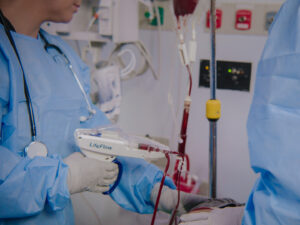
Recognizing the patient’s critical condition, the trauma team used LifeFlow to rapidly administer one unit of low-titer O whole blood in approximately two minutes.
The patient demonstrated an immediate hemodynamic response, with blood pressure improving to 138/88 mmHg. No additional blood products, intravenous fluids, or vasopressors were required during the initial trauma resuscitation.
Outcome
Following stabilization, the patient underwent CT imaging and was admitted to the neurosurgical/neurocritical care ICU for ongoing management of his traumatic brain injury.
Clinician Feedback
The treating nurse reported that LifeFlow provided confidence that blood products could be delivered rapidly during a time-critical trauma resuscitation. The device was described as intuitive and easy to set up, allowing clinicians familiar with blood administration to quickly begin transfusion.
Clinical Discussion
Trauma patients with severe head injuries often require rapid hemodynamic stabilization to support adequate cerebral perfusion while definitive evaluation and treatment are underway. Particularly for patients with hemorrhage, early blood transfusion is essential to restore circulating volume, oxygen-carrying capacity, and clotting factors. Since every minute of hypotension increases mortality for patients with TBI, the effectiveness of resuscitation depends on how quickly blood products can be delivered. This case demonstrates how rapid blood administration can efficiently stabilize a critically injured patient during the initial phase of trauma resuscitation.